Comparing hashes
A hash on its own says nothing; two of them compared say how alike two images are, and a threshold on that comparison says whether they are the same picture. This page describes the four ways the library compares, which one goes with which algorithm, and what a threshold costs, measured for all nine algorithms on the two corpora the algorithm pages use. It ends with the text form in which hashes are stored and read back, and with what makes a stored hash comparable with one computed on another machine.
Which function for which hash
Every digest says what its bytes hold in its kind field, and each comparison function
accepts one kind:
kind |
Produced by | Compare with | Result |
|---|---|---|---|
PH_DIGEST_KIND_BITS |
aHash, dHash, pHash, wHash (as a digest), mHash, BMH | ph_hamming_distance_digest(), ph_similarity_digest() |
bits that differ, 0 to 8 × size; share of equal bits, 0.0 to 1.0 |
PH_DIGEST_KIND_COEFFICIENTS |
Radial | ph_radial_similarity() |
peak correlation, −1.0 to 1.0 |
PH_DIGEST_KIND_HISTOGRAM |
ColorHash | ph_histogram_intersection() |
the share the two histograms have in common, 0.0 to 1.0 |
PH_DIGEST_KIND_VECTOR16 |
ColorMoments | ph_l2_distance() |
Euclidean distance, 0.0 and up |
PH_DIGEST_KIND_VECTOR |
none: a feature vector the caller builds | ph_l2_distance() |
Euclidean distance, 0.0 and up |
The four 64-bit hashes also come as a plain uint64_t, compared with
ph_hamming_distance() (0 to 64) and
ph_similarity().
Given a digest of another kind, a function refuses rather than answer. A Hamming distance
over Radial's quantized coefficients would be a plausible-looking integer that means
nothing, and the tag exists so that such a call fails. The distance and similarity
functions return −1 for it; ph_radial_similarity() and ph_histogram_intersection(),
whose result goes through a pointer, return
PH_ERR_INVALID_ARGUMENT. The same answer
comes back for a NULL pointer, two digests of different sizes, or a size of 0 or above
PH_DIGEST_MAX_BYTES: a size of 0 has no bits to
compare, and a distance of 0 for it would read as "identical".
/* The wrong metric is refused, not answered with a meaningless number: a radial
 * digest is quantized coefficients, not a bit vector. */
printf("hamming distance of two radial digests: %d (refused)\n",
       ph_hamming_distance_digest(&da[2], &db[2]));
PH_DIGEST_KIND_UNSPECIFIED, the zero
that a struct filled in by hand holds, is accepted by every function. A binding that sets
only data and size gets no check, and no error either.
Bits: Hamming distance and similarity
Six algorithms set bits, and two of their hashes are compared by the number of bit positions in which they differ, the Hamming distance. Over a digest of \(n\) bytes,
and the similarity is the share of bits that agree,
For a uint64_t hash \(n\) is 8: ph_hamming_distance() is the popcount of a ^ b, and
ph_similarity() is \(1 - d / 64\). The two forms agree:
ph_compute_digest() returns a 64-bit hash as an
8-byte digest with its most significant byte first, so the digest functions on two such
digests give exactly what the uint64_t functions give on the two hashes.
Two hashes of unrelated images differ in about half of their bits, whatever the length: on both corpora, the median distance between different images is half of the 64, 256 or 576 bits, or within a few bits of it. The similarity puts every length on that one scale, 1 for identical and about 0.5 for unrelated. It does not make thresholds comparable, though: how close a copy comes depends on the algorithm, and below a copy of an mHash digest scores barely above 0.5 where a copy of an aHash scores above 0.9.
Radial: peak correlation
Radial's 40 bytes are quantized coefficients of a profile around the image's center (Radial), numbers rather than bits. Two digests \(a\) and \(b\) of \(n\) bytes are compared by the Pearson correlation of their bytes, with \(b\) shifted cyclically by every \(k\) from 0 to \(n - 1\), and the largest of the \(n\) is the score:
It runs from −1 to 1, and 1 means the same shape up to a shift. A rotation of the image shifts its profile, and the maximum over shifts is meant to find it again; on the digest the score holds through a few degrees and a half turn, as the Radial page measures. Swapping \(a\) and \(b\) gives the same score.
A digest whose bytes are all equal has no spread, and no correlation is defined against
it. ph_compute_radial_hash() returns such a
digest, all zeros, for an image with no angular structure (flat, or the same in every
direction), and ph_radial_similarity() answers a pair with one in it with
PH_ERR_NO_STRUCTURE. Any number would be
invented, and 1.0 would call two unrelated flat images identical; whether "no data" counts
as a match is the caller's decision.
PH_RADIAL_PCC_THRESHOLD, 0.9, is the score
at which the algorithm's source takes two images to be the same. It is a starting point
with a citation behind it, not a value measured for a collection. On the two corpora:
| Corpus | Copies at PH_RADIAL_PCC_THRESHOLD (0.9) or above |
Different pairs at 0.9 or above | Threshold for 95% of copies |
|---|---|---|---|
| synthetic corpus, 24 images; not photographs | 91.8% | 3.0% | 0.751 |
| 200 public-domain photographs from Wikimedia Commons | 99.6% | 0.1% | 0.956 |
On the photographs 0.9 accepts nearly every copy and lets very few different pairs through. On the synthetic images it accepts fewer copies than the threshold below that is set for 95 % of them, and more different pairs than on the photographs.
Histograms: intersection
ColorHash's 108 bytes are a histogram of the image's colors (ColorHash), one count per bin. Two histograms \(a\) and \(b\), with totals \(A\) and \(B\), are compared by their intersection, the share of each that the other also holds:
It is 1 for the same distribution of colors and 0 for two images with no color in common. Two empty histograms score 1, and an empty one against another 0. Swain and Ballard divide both by the reference histogram's total, which makes the score depend on the order of its arguments when the two images have different numbers of pixels; dividing each by its own total gives the same number when the counts match, and the same number both ways when they do not. The library computes the sum in integers, as \(\sum_i \min(a_i B, b_i A) / (AB)\), so that a histogram compared with itself scores exactly 1.
Feature vectors: L2 distance
ColorMoments' 18 bytes are nine numbers, a mean, a spread and a skewness for each of red,
green and blue (ColorMoments), each a signed 16-bit
integer in units of \(1/128\) of a level
(PH_VECTOR16_SCALE). Two of them are compared by
the Euclidean distance between the decoded numbers \(u\) and \(v\):
in channel levels, 0 for identical moments, with no upper end that a threshold could be
read against. A digest of PH_DIGEST_KIND_VECTOR holds one unsigned byte per feature and
is compared the same way, byte by byte. A digest of PH_DIGEST_KIND_VECTOR16 with an odd
number of bytes is refused, as half a number.
Choosing a threshold
A comparison becomes a decision when a threshold is placed on it: two images are the same when their score is at the threshold or closer. Every threshold accepts some share of the copies of an image and lets through some share of pairs of different images, and moving it trades one against the other. Here, as on the algorithm pages, a copy is an image of a corpus after one moderate edit (one strength of each of the nine edits: JPEG, downscale, rotation, brightness, contrast, gamma, blur, noise, crop), and different images are every pair of distinct images of the corpus.
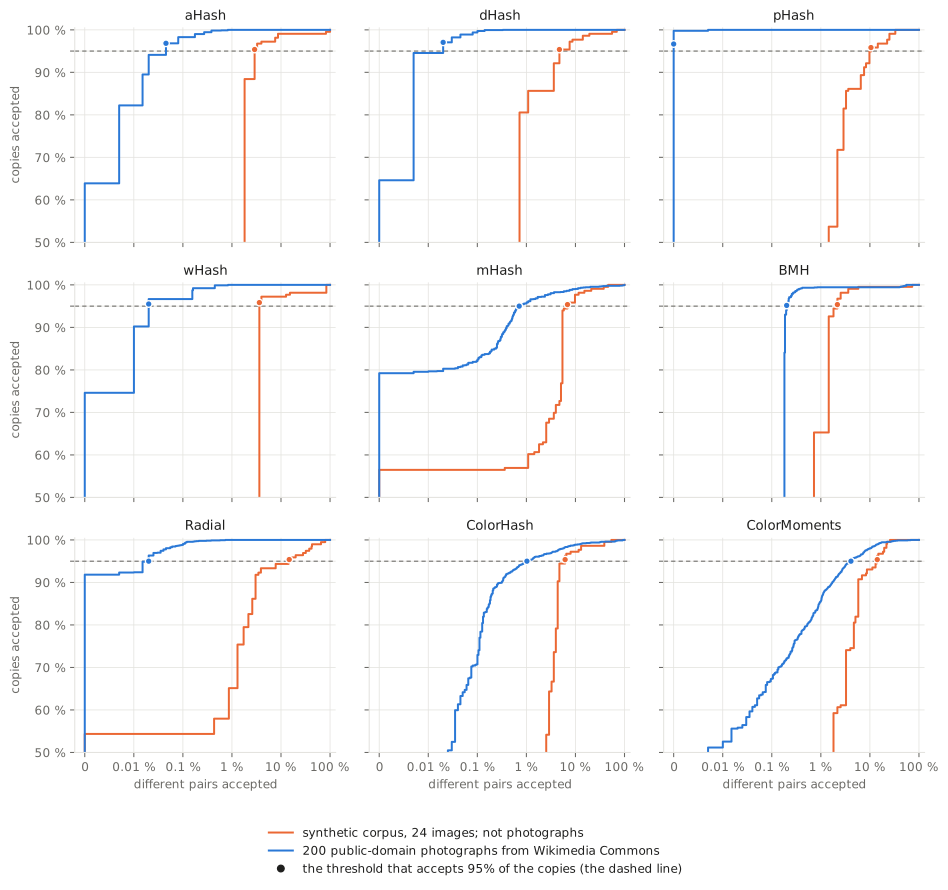
Each curve is one corpus, and each point on it one threshold: how many copies it accepts (up) against how many different pairs it lets through as well (right, on a logarithmic scale, with 0 at the left edge). A curve that climbs high at the left edge separates well. The dot is the threshold that accepts 95 % of the copies, the one the algorithm pages mark.
| Algorithm | Synthetic images: threshold | different pairs within | Photographs: threshold | different pairs within |
|---|---|---|---|---|
| aHash | ≤ 8 of 64 bits (similarity ≥ 0.875) | 2.9% | ≤ 4 of 64 bits (similarity ≥ 0.938) | 9 of 19,900 |
| dHash | ≤ 15 of 64 bits (similarity ≥ 0.766) | 4.7% | ≤ 7 of 64 bits (similarity ≥ 0.891) | 4 of 19,900 |
| pHash | ≤ 17 of 64 bits (similarity ≥ 0.734) | 10.5% | ≤ 7 of 64 bits (similarity ≥ 0.891) | 0 of 19,900 |
| wHash | ≤ 16 of 64 bits (similarity ≥ 0.750) | 3.6% | ≤ 4 of 64 bits (similarity ≥ 0.938) | 4 of 19,900 |
| mHash | ≤ 255 of 576 bits (similarity ≥ 0.557) | 6.9% | ≤ 251 of 576 bits (similarity ≥ 0.564) | 0.7% |
| BMH | ≤ 43 of 256 bits (similarity ≥ 0.832) | 2.2% | ≤ 23 of 256 bits (similarity ≥ 0.910) | 0.2% |
| Radial | ≥ 0.751 | 14.7% | ≥ 0.956 | 4 of 19,900 |
| ColorHash | ≥ 0.615 | 6.2% | ≥ 0.775 | 1.0% |
| ColorMoments | ≤ 58.8 | 14.1% | ≤ 43.5 | 4.1% |
- The threshold belongs to the collection. For every algorithm, the synthetic images need a looser threshold than the photographs to accept 95 % of their copies, and that threshold lets through a larger share of different pairs. The synthetic images are checkerboards, stripes, rings and discs: their copies move further than a photograph's, and their different images are more alike than two photographs are. A threshold measured on one collection is a guess on another.
- A similarity is not a threshold. The similarity of the 95 % threshold runs from little above the 0.5 of unrelated images, for mHash, to above 0.9, for aHash, wHash and BMH on the photographs. One similarity cut applied to several algorithms is a different decision for each.
- The last copies are the dearest. The table under the chart gives the threshold for 90 %, 95 % and 99 % of the copies. For nearly every algorithm, on both corpora, the 99 % threshold lets through several times as many different pairs as the 95 % one: the copies it adds are the hardest edits, and they sit among the different images. pHash on the photographs lets through none at any of the three.
The numbers behind the chart
| Algorithm | Corpus | 90% of copies | 95% of copies | 99% of copies |
|---|---|---|---|---|
| aHash | Synthetic images | ≤ 8 bits: 2.9% | ≤ 8 bits: 2.9% | ≤ 20 bits: 8.7% |
| aHash | Photographs | ≤ 3 bits: 4 of 19,900 | ≤ 4 bits: 9 of 19,900 | ≤ 6 bits: 0.2% |
| dHash | Synthetic images | ≤ 12 bits: 3.6% | ≤ 15 bits: 4.7% | ≤ 23 bits: 19.2% |
| dHash | Photographs | ≤ 5 bits: 1 of 19,900 | ≤ 7 bits: 4 of 19,900 | ≤ 10 bits: 16 of 19,900 |
| pHash | Synthetic images | ≤ 13 bits: 7.6% | ≤ 17 bits: 10.5% | ≤ 24 bits: 25.0% |
| pHash | Photographs | ≤ 5 bits: 0 of 19,900 | ≤ 7 bits: 0 of 19,900 | ≤ 9 bits: 0 of 19,900 |
| wHash | Synthetic images | ≤ 6 bits: 3.6% | ≤ 16 bits: 3.6% | ≤ 32 bits: 84.1% |
| wHash | Photographs | ≤ 3 bits: 2 of 19,900 | ≤ 4 bits: 4 of 19,900 | ≤ 7 bits: 0.2% |
| mHash | Synthetic images | ≤ 213 bits: 5.4% | ≤ 255 bits: 6.9% | ≤ 277 bits: 21.0% |
| mHash | Photographs | ≤ 232 bits: 0.4% | ≤ 251 bits: 0.7% | ≤ 270 bits: 8.7% |
| BMH | Synthetic images | ≤ 23 bits: 1.4% | ≤ 43 bits: 2.2% | ≤ 72 bits: 3.6% |
| BMH | Photographs | ≤ 17 bits: 0.2% | ≤ 23 bits: 0.2% | ≤ 37 bits: 0.4% |
| Radial | Synthetic images | ≥ 0.922: 3.0% | ≥ 0.751: 14.7% | ≥ 0.361: 65.4% |
| Radial | Photographs | ≥ 0.973: 0 of 19,900 | ≥ 0.956: 4 of 19,900 | ≥ 0.913: 0.1% |
| ColorHash | Synthetic images | ≥ 0.726: 4.3% | ≥ 0.615: 6.2% | ≥ 0.123: 38.8% |
| ColorHash | Photographs | ≥ 0.840: 0.3% | ≥ 0.775: 1.0% | ≥ 0.582: 12.2% |
| ColorMoments | Synthetic images | ≤ 38.0: 5.8% | ≤ 58.8: 14.1% | ≤ 67.0: 21.7% |
| ColorMoments | Photographs | ≤ 32.9: 1.7% | ≤ 43.5: 4.1% | ≤ 71.4: 14.3% |
Each cell is the threshold that accepts that share of the copies, and the share of different pairs it lets through as well. synthetic corpus, 24 images; not photographs: 216 copies and 276 different pairs; 200 public-domain photographs from Wikimedia Commons: 1,800 copies and 19,900 different pairs.
For Radial: left out, because the comparison refuses an image with no angular structure: synthetic corpus, 24 images; not photographs: 109 edited images and 45 pairs of different images.
How this was measured
The values are the ones the algorithm pages chart: for each corpus, every image is edited with each of the nine edits, and the copy is compared with the original by the algorithm's own function, and every pair of distinct originals is compared the same way. The copies are one strength of each edit; the curve is every threshold the measured values allow, and the 95 % threshold is the closest value that still accepts 95 % of the copies. Nothing is measured for this page: it reads the measurements of the algorithm pages from the cache. Below is the code that ran, not a copy of it.
# A "copy" is an original after one moderate edit: one strength of each transform, the
# kind of change a picture goes through between two places it is stored.
COPY_STRENGTHS = {
    "JPEG quality": 50,
    "Downscale": 0.5,
    "Rotation": 2,
    "Brightness": 1.15,
    "Contrast": 1.15,
    "Gamma": 1.2,
    "Gaussian blur": 1,
    "Noise": 5,
    "Crop": 5,
}
def separability(copies, different, lower_is_closer, recall=RECALL):
    """d', the threshold that keeps `recall` of the copies (RECALL unless a page asks for
    another share), and the share of different pairs that threshold also accepts.

    d' is the gap between the two means in units of their pooled spread, as
    tests/src/test_hash_properties.c defines it (separability()), signed so that a
    positive d' means copies are closer than different images.
    """
    c, d = np.asarray(copies, float), np.asarray(different, float)
    sign = 1.0 if lower_is_closer else -1.0
    pooled = np.sqrt((c.std() ** 2 + d.std() ** 2) / 2.0)
    dprime = sign * (d.mean() - c.mean()) / pooled if pooled > 0 else float("inf")
    # The threshold: the closest value that still accepts `recall` of the copies.
    t = sign * np.quantile(sign * c, recall, method="inverted_cdf")
    accepted = (d <= t) if lower_is_closer else (d >= t)
    return dprime, t, accepted.mean()
def curve(copies, different, lower_is_closer):
    """Every threshold the values allow, as (share of copies accepted, share of different
    pairs accepted): a pair is accepted when its value is at the threshold or closer. The
    first point is a threshold stricter than any value, which accepts nothing."""
    c, d = np.asarray(copies, float), np.asarray(different, float)
    sign = 1.0 if lower_is_closer else -1.0
    ts = np.unique(sign * np.concatenate([c, d]))
    accepted_c = np.searchsorted(np.sort(sign * c), ts, side="right") / len(c)
    accepted_d = np.searchsorted(np.sort(sign * d), ts, side="right") / len(d)
    return np.r_[0.0, accepted_c], np.r_[0.0, accepted_d]
def measure_corpus(tool, corpus):
    """{"n", "label", "robust": {algo: {transform: [[strength, [value per image]]]}},
    "edits": {the same, for the edits that change the picture}, "different": {algo:
    [value per pair]}} for one corpus, from the cache when nothing that decides it has
    changed. Values are each algorithm's own metric, as `site_stages measure` and
    `site_stages pairs` print it; None where it does not apply."""
    paths = images(tool, corpus)

    def measure():
        with tempfile.TemporaryDirectory() as tmp:
            # The originals are decoded once, by Pillow, and written losslessly, so that
            # the reference an edit is compared with and the image that is edited are the
            # same pixels.
            refs = [os.path.join(tmp, f"{i:04d}.ppm") for i in range(len(paths))]
            with concurrent.futures.ProcessPoolExecutor() as pool:
                per_image = list(pool.map(_measure_one, [(tool, p, r) for p, r in
                                                         zip(paths, refs)]))
            rows = run_lines(tool, "pairs", *refs) if len(refs) >= 2 else []

        robust, edits = {}, {}
        content = {name for name, _, _ in content_edits()}
        for result in per_image:
            for algo, by_transform in result.items():
                for name, points in by_transform.items():
                    group = edits if name in content else robust
                    slot = group.setdefault(algo, {}).setdefault(
                        name, [[s, []] for s, _ in points])
                    for (strength, value), cell in zip(points, slot):
                        cell[1].append(value)
        different = {}
        for row in rows:
            for algo, value in row.items():
                if algo not in ("a", "b"):
                    different.setdefault(algo, []).append(value)
        return {"n": len(paths), "label": label(corpus, len(paths)), "robust": robust,
                "edits": edits, "different": different}

    return cached(corpus, cache_key(paths), measure, f"{corpus} corpus, {len(paths)} images")
/* One algorithm's comparison of two digests by its own metric; 0 when it does not apply. */
static int compare(const ph_digest_t *a, const ph_digest_t *b, double *out) {
    switch (a->kind) {
        case PH_DIGEST_KIND_BITS:
            *out = ph_similarity_digest(a, b);
            return *out >= 0.0;
        case PH_DIGEST_KIND_COEFFICIENTS:
            return ph_radial_similarity(a, b, out) == PH_SUCCESS;
        case PH_DIGEST_KIND_HISTOGRAM:
            return ph_histogram_intersection(a, b, out) == PH_SUCCESS;
        case PH_DIGEST_KIND_VECTOR16:
            *out = ph_l2_distance(a, b);
            return *out >= 0.0;
        default:
            return 0;
    }
}
What counts as a copy
A threshold set for 95 % of all the copies does not accept 95 % of each kind. Here is the share of each edit's copies that it accepts:
synthetic corpus, 24 images; not photographs
| Algorithm | JPEG | Downscale | Rotation | Brightness | Contrast | Gamma | Blur | Noise | Crop |
|---|---|---|---|---|---|---|---|---|---|
| aHash | 100% | 100% | 92% | 100% | 100% | 92% | 100% | 96% | 79% |
| dHash | 100% | 96% | 92% | 100% | 96% | 96% | 92% | 96% | 92% |
| pHash | 100% | 100% | 83% | 96% | 100% | 100% | 100% | 83% | 100% |
| wHash | 92% | 100% | 96% | 100% | 100% | 100% | 100% | 92% | 83% |
| mHash | 100% | 100% | 100% | 100% | 100% | 100% | 100% | 79% | 79% |
| BMH | 96% | 100% | 88% | 100% | 100% | 100% | 100% | 96% | 79% |
| Radial | 95% | 86% | 95% | 100% | 95% | 100% | 95% | 95% | 95% |
| ColorHash | 83% | 92% | 100% | 100% | 100% | 100% | 88% | 96% | 100% |
| ColorMoments | 96% | 100% | 100% | 92% | 100% | 71% | 100% | 100% | 100% |
200 public-domain photographs from Wikimedia Commons
| Algorithm | JPEG | Downscale | Rotation | Brightness | Contrast | Gamma | Blur | Noise | Crop |
|---|---|---|---|---|---|---|---|---|---|
| aHash | 100% | 100% | 96% | 100% | 100% | 98% | 100% | 100% | 78% |
| dHash | 100% | 100% | 88% | 100% | 100% | 100% | 100% | 100% | 86% |
| pHash | 100% | 100% | 88% | 100% | 100% | 100% | 100% | 100% | 82% |
| wHash | 100% | 100% | 86% | 99% | 100% | 99% | 100% | 100% | 76% |
| mHash | 100% | 100% | 94% | 100% | 100% | 100% | 100% | 100% | 61% |
| BMH | 100% | 100% | 86% | 99% | 100% | 100% | 100% | 100% | 72% |
| Radial | 100% | 94% | 66% | 98% | 100% | 100% | 100% | 100% | 98% |
| ColorHash | 98% | 100% | 100% | 80% | 96% | 95% | 100% | 86% | 100% |
| ColorMoments | 100% | 96% | 100% | 86% | 100% | 83% | 94% | 100% | 96% |
The copies left outside are the edits each algorithm's design does not absorb. On the photographs, for the hashes of the image's layout (aHash to BMH), they are the crop and the rotation, which move content between cells; for Radial, the rotation; for the two color hashes, brightness and gamma, which move colors between bins and shift the moments, while a rotation leaves them untouched. The synthetic images, with their checkerboards and stripes, add other misses, noise for pHash and mHash among them. A collection whose copies are never cropped can take a stricter threshold than these, and one whose copies lose more than the 5 % border removed here needs a looser one, or a hash that tolerates it.
Measuring a threshold on your own collection
The same measurement fits any collection, with the library's comparison functions:
- Collect pairs that are known to be the same picture, with the edits your copies actually go through, and pairs that are known to be different, as many as you can.
- Compare every pair with the function for the algorithm's digest.
- Sort the scores of the copies and take the one at the share of copies you need accepted (the 95th percentile, for 95 %). That is the threshold; count the different pairs at it or closer, and that is its price.
If that price is too high, no threshold of that algorithm will do, and the choice is another algorithm: the curves above show which separate better on images like the photographs and like the synthetic set.
Hashes as text
A hash stored in a database or sent to another process goes as text.
ph_hash_to_hex()writes a 64-bit hash as 16 lowercase hexadecimal digits, the most significant byte first, andph_hash_from_hex()reads exactly 16 digits back, in either case, with nothing before or after them.ph_digest_to_hex()writes a digest as its kind, a colon and its bytes, byte 0 first:bits:…,coefficients:…,histogram:…,vector16:….ph_digest_from_hex()requires the prefix and restores the kind with the bytes, so two digests read back from storage are refused the wrong comparison exactly as two fresh ones are. A string without a prefix is refused rather than read as untagged;unspecified:in front of it accepts it knowingly.PH_DIGEST_HEX_BUFFER_SIZEholds the text of any digest.
A 64-bit hash taken as a digest has its bytes in the same order, so its text is bits:
followed by the 16 digits of ph_hash_to_hex().
/* Store a digest as text and read it back; the text carries the kind. */
char hex[PH_DIGEST_HEX_BUFFER_SIZE];
ph_digest_t back;
if (ph_digest_to_hex(&da[1], hex, sizeof(hex)) != PH_SUCCESS ||
    ph_digest_from_hex(hex, &back) != PH_SUCCESS) {
    fprintf(stderr, "hex round trip failed\n");
    ph_free(ctx);
    return 1;
}
printf("BMH as text: %s\n", hex);
printf("read back: %s\n", (back.size == da[1].size && back.kind == da[1].kind &&
                           memcmp(back.data, da[1].data, back.size) == 0)
                              ? "identical"
                              : "DIFFERENT");
Same hash on every machine
A stored hash is worth comparing only if a hash computed elsewhere would have come out the
same. A hash is a function of the decoded pixels and the context's settings, and the
library computes it the same way on every machine: no fused multiply-add contraction, one
plain loop for pHash's DCT, integer area averaging and grayscale conversion, exact
histogram intersection, and Radial's correlations summed in integers and rounded once,
at the end. A build for arm64 or x86-64, with GCC, Clang or MSVC, with or
without SIMD, gives the same bits; tests/src/test_golden_hashes.c holds every algorithm
to that exactly, with no tolerance.
The one thing that changes the pixels is the JPEG decoder. libjpeg-turbo (the bundled
decoder of the CMake build) and stb_image (the zero-dependency fallback) round their
inverse DCT differently, so the same JPEG reaches the hash functions as slightly
different pixels. ph_get_build_info() names the
decoder (jpeg=libjpeg-turbo or jpeg=stb). PNG and WebP decode to the same pixels in
every build.
For a collection of stored hashes this means:
- Hashes from builds with the same JPEG decoder can be compared by equality.
- Across the two JPEG decoders, compare by distance with a threshold, never by equality. On the test fixtures the 64-bit hashes and BMH come out the same; mHash differs by 3 or 4 of its 576 bits, and Radial, ColorHash and ColorMoments by small amounts in a few of their features.
- Settings that change the pixels a hash sees, such as
ph_context_set_decode_scale(),ph_context_set_gamma(),ph_context_set_gray_weights()andph_context_set_auto_orient(), are part of a hash's identity just like the algorithm's own parameters. Store them with the hashes.
In code
Two images compared by pHash, as a Hamming distance and a similarity:
/* Compares two images with pHash and prints a normalized similarity score. Build/run:
 *   cc compare_two_images.c -o compare_two_images $(pkg-config --cflags --libs libphash)
 *   ./compare_two_images a.jpg b.jpg
 */
#include <libphash.h>
#include <stdio.h>

static int hash_file(const char *path, uint64_t *out_hash) {
    ph_context_t *ctx = NULL;
    if (ph_create(&ctx) != PH_SUCCESS) {
        fprintf(stderr, "ph_create failed\n");
        return 1;
    }
    ph_context_set_load_grayscale(ctx, 1);

    ph_error_t err = ph_load_from_file(ctx, path);
    if (err != PH_SUCCESS) {
        fprintf(stderr, "failed to load %s: %s (%s)\n", path, ph_get_error_string(err),
                ph_get_last_error_message(ctx));
        ph_free(ctx);
        return 1;
    }

    err = ph_compute_phash(ctx, out_hash);
    ph_free(ctx);
    if (err != PH_SUCCESS) {
        fprintf(stderr, "ph_compute_phash failed for %s: %s\n", path, ph_get_error_string(err));
        return 1;
    }
    return 0;
}

int main(int argc, char **argv) {
    if (argc != 3) {
        fprintf(stderr, "usage: %s <image-a> <image-b>\n", argv[0]);
        return 1;
    }

    uint64_t hash_a, hash_b;
    if (hash_file(argv[1], &hash_a) != 0 || hash_file(argv[2], &hash_b) != 0) {
        return 1;
    }

    int distance = ph_hamming_distance(hash_a, hash_b);
    double similarity = ph_similarity(hash_a, hash_b);

    printf("Hamming distance: %d/64 bits\n", distance);
    printf("Similarity:       %.4f (1.0 = identical, 0.0 = every bit differs)\n", similarity);

    return 0;
}
Each digest compared with the function its kind calls for, from the example that hashes two images with every digest algorithm:
/* Compares two digests of one algorithm with the function its kind calls for. */
static void compare(const char *name, const ph_digest_t *a, const ph_digest_t *b) {
    double score = 0.0;
    switch ((ph_digest_kind_t)a->kind) {
        case PH_DIGEST_KIND_BITS:
            printf("%-13s %3d of %d bits differ, similarity %.3f\n", name,
                   ph_hamming_distance_digest(a, b), a->size * 8, ph_similarity_digest(a, b));
            break;
        case PH_DIGEST_KIND_COEFFICIENTS:
            if (ph_radial_similarity(a, b, &score) == PH_SUCCESS) {
                printf("%-13s peak correlation %.3f (same image at %.1f and above)\n", name, score,
                       PH_RADIAL_PCC_THRESHOLD);
            } else {
                printf("%-13s no angular structure to compare\n", name);
            }
            break;
        case PH_DIGEST_KIND_HISTOGRAM:
            if (ph_histogram_intersection(a, b, &score) == PH_SUCCESS) {
                printf("%-13s histogram intersection %.3f\n", name, score);
            }
            break;
        case PH_DIGEST_KIND_VECTOR16:
        case PH_DIGEST_KIND_VECTOR:
            printf("%-13s L2 distance %.2f\n", name, ph_l2_distance(a, b));
            break;
        default:
            printf("%-13s kind %d: no comparison\n", name, a->kind);
            break;
    }
}